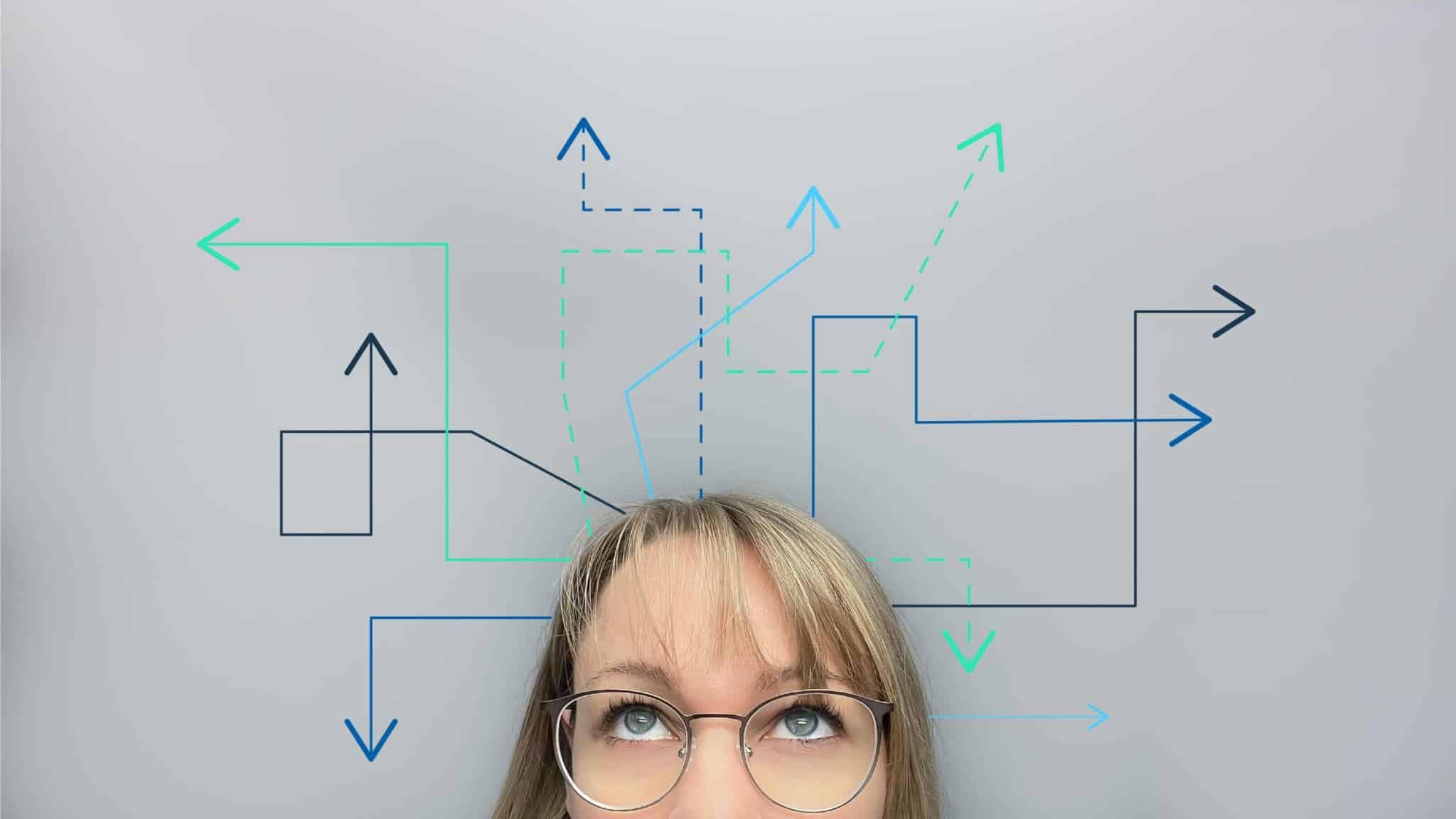
We make around 20,000 decisions every day. Fortunately, most of them are fairly trivial. But in the new agile learning Netstream, leadership is distributed, so we are now increasingly making important decisions too. But what does it actually mean to make decisions?
By becoming an agile learning organisation, Netstream AG wants to distribute leadership and thus respond flexibly and quickly to market demands. As we all know, «marketing» comes from «market». So how could I, as a marketer, reject a system that aligns its entire structure with the market – and in which I even get to make decisions? Ever since the new leadership system was announced, I had been eagerly awaiting the transformation.
A good five months ago, I was transformed into the «Cloud» business circle together with four colleagues. The cloud circle is the direct link to the market and to customers, and is responsible for the portfolio as well as for implementing the solutions. In our circle, we have distributed leadership among all colleagues. This means that we no longer wait for decisions from «above»; instead, the authority lies directly within the circle, within a given framework that we can shape ourselves. Sounds heavenly – doesn’t it? I already had some decisions to make in my area of responsibility before, but now I face the challenge of also helping to decide on supposedly new topics from a business perspective. That gives the word «decision» a whole new meaning.
A daily mass of decisions
Every single day, we make around 20,000 decisions. Most decisions are not only made at record speed, but also largely unconsciously. It starts early in the morning when I decide on the spur of the moment to press the «snooze» button on my alarm clock, continues at some point in front of my wardrobe and carries on all the way to the coffee machine in the office, whose wide selection is no help at all. Even the decision to stick to habit is a choice. Fortunately, most decisions are trivial and do not have major consequences – at least not significant ones. But in everyday working life, there is no end to making decisions. They should be made as wisely and efficiently as possible and, of course, always with an eye on cost-effectiveness.
We are influenced by feelings and fears
However, every time we decide in favour of something, we also rule out a whole range of alternatives. As a result, every decision also involves a loss (whatever we ultimately decided against). We tend to dwell far more on the loss and mourn it than to be pleased about what we decided. Out of fear of loss, we therefore make decisions that promise us a short-term reward. But we should not let our fears get in our way. Feelings also interfere with our decisions. So we should be aware of them – without turning into robots in everyday life.
Decisions have a long-term impact
Often, however, decisions also have a rather long-term impact. That doesn’t exactly make decision-making easier – I know. We have to make a decision here and now whose impact we will only see in the future. Sometimes we are talking about years before the goal is reached. So we always have a certain level of knowledge with which we try to make the best possible decision, and to a certain extent we are always making assumptions – we are not clairvoyants.
The decision
Bearing all of the above in mind, deciding no longer seems quite so easy. Now we are supposed to decide as efficiently as possible and for the good of the company. We are influenced by various feelings or fears. Many of the decisions are fairly long-term and inevitably have consequences. On top of that, we have an urge for perfection.
But now comes the brilliant thing about agility: we are allowed to adapt and improve decisions! Because on the way to the goal, we gather more information and sometimes run into difficulties. These experiences always make us a little wiser and enable us to improve the path to the goal a little. In addition, we make an effort to be self-reflective. Self-reflection would certainly deserve a blog post of its own. At its core, it is about being clear before every decision which feelings and fears surround you, expressing them and finding a solution. The very strict decision-making process we work with helps here (more on that in a future blog post). In the end, we take a new path and get a great opportunity to be part of the solution.
Conclusion
It is certainly not easy to take part in all the decisions in the team and to stand behind them. But the good thing is that we are all in the same boat. What’s more, we all have the same goal. We all want to work in a market-oriented and agile way and make and support decisions together. So I cannot reject a system that aligns itself with the market and in which I get to have a say. We have taken the first step and already made the most important decision – we want change and we are on board! Now comes the learning process, many more decisions, feelings and fears, paired with a healthy dose of courage.
Read more about this process in the «Organisational development» section