







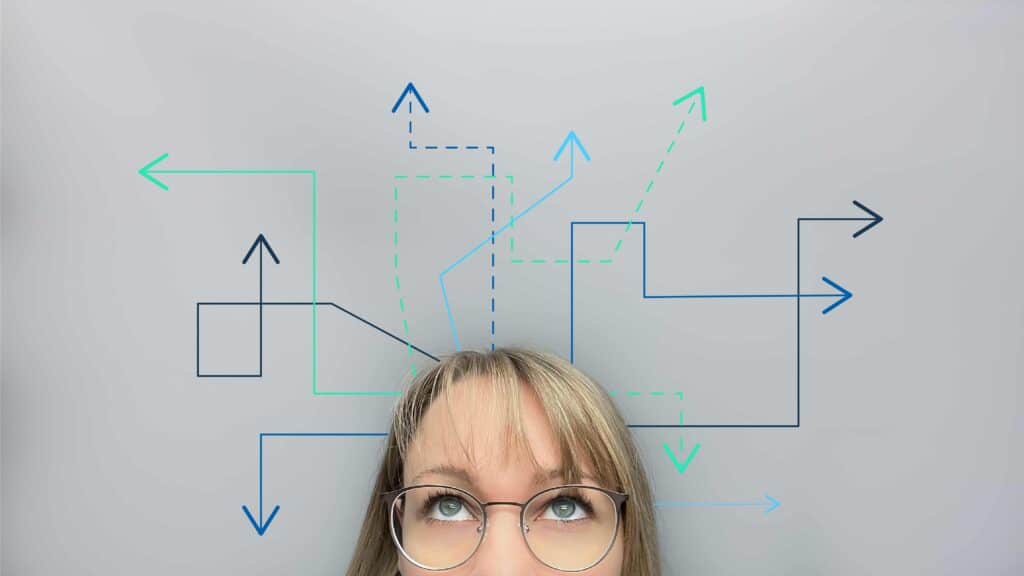
Every day we make around 20,000 decisions. Fortunately, most of them are rather trivial. But in the new ag, learning-based Netstream , leadership is distributed, and so we are now making more important decisions. But what does it actually mean to make decisions?
With its move to an ag, learning organization, Netstream AG aims to distribute leadership and thusagflexibly and responsively to market demands. As we all know, "marketing" comes from "market." So how could I, as a marketer, reject a system that aligns its entire structure with the market, and in which I even have a say? I have therefore been eagerly awaiting this transformation ever since the announcement of the new leadership system.
About five months ago, I and four colleagues were transformed into the "Cloud" business unit. The Cloudunit is the direct link to the market and customers, responsible for the portfolio and the implementation of solutions. Within our unit, we've distributed leadership among all colleagues. This means we no longer wait for decisions from "above," but rather, within a given, manageable framework, the expertise resides directly within the unit. Sounds fantastic, doesn't it? While I already had to make some decisions within my area of responsibility, I now face the challenge of also contributing to decisions on seemingly new topics with a focus on economics. The word "decision" takes on a whole new meaning in this context.
Daily decision-making
ag, we make around 20,000 decisions. Most of these decisions happen not only at record speed but also largely unconsciously. It starts early in the morning when I impulsively decide to hit the snooze button on my alarm, continues at some point in front of my wardrobe, and extends to the office coffee machine, whose vast selection is of little help. Even the decision to follow habit is a choice. Fortunately, most decisions are trivial and don't entail significant causal relationships. But decision-makingag ends in the workplace. Decisions should be made as intelligently and efficiently as possible, and of course, always with an eye toward cost-effectiveness.
We are influenced by feelings and fears
With every decision we make, we simultaneously exclude a multitude of alternatives. As a result, every decision is also linked to a loss (whatever we ultimately decided against). We tend to dwell on the loss far more and mourn it rather than rejoice in the decision. Out of fear of loss, we make choices that promise short-term rewards. However, we shouldn't let our fears hold us back. Feelings also influence our decisions. We should be aware of these feelings, yet still avoid becoming robots in everydayag .
Decisions have long-term consequences
However, decisions often have a long-term impact. This doesn't exactly simplify decision-making – I know. We have to make a decision in the here and now, but we won't see the consequences until the future. Sometimes we're talking about years that can pass before we reach our goal. Therefore, we always have a certain level of knowledge with which we try to make the best possible decision, and we always make assumptions to some extent – we're not clairvoyant.
The decision
Considering what's been written above, making decisions doesn't seem so simple anymore. Now we're supposed to make decisions as efficiently as possible and in the best interests of the company. We're influenced by various feelings and fears. Many of the decisions are quite long-term and inevitably lead to causal relationships. On top of that, we have a drive for perfection.
But here's the brilliant thing about Ag: We can adapt and improve our decisions! Because on the way to our goal, we gather more information and sometimes encounter difficulties. These experiences always make us a little wiser and enable us to refine our approach. In addition, we strive to be self-reflective. Self-reflection certainly deserves its own blog post. Essentially, it's about being aware of the feelings and fears surrounding you before making any decision, expressing them, and finding a solution. The very rigorous decision-making process we use helps with this (more on that in a future blog post). Ultimately, weagon a new path and gain a great opportunity to be part of the solution.
Conclusion
It's certainly not easy to make andagall decisions as a team. But the good thing is, we're all in the same boat. What's more, we all share the same goal. We all want to work in a market-oriented and agway, and make andagdecisions together. So, I can't reject a system that's market-driven and where I have a say. We've taken the first step and already made the most important decision – we want change, and we're on board! Now comes the learning process, many more decisions, feelings, and anxieties, coupled with a healthy dose of courage.
You can read more about this process in the section "Organizational Development".